Redeployable CCTV in public space: the Berlin police at Alexanderplatz
The Berlin police put Mobile Security Box units on Alexanderplatz. What that says about policing a hotspot that keeps moving, and what redeployable CCTV has to deliver.

In this article
Your operational picture changes every fortnight. The camera estate you inherited does not. Somewhere in your city there is a square where the incidents cluster, and the nearest pole-mounted camera is pointed at where the trouble was two years ago. Berlin ran into the same problem on Alexanderplatz and reached for something movable.
Three questions decide whether movable cameras earn their budget line. Can the position change as fast as the operational picture? Will it stand without power, groundwork or planning consent? And does it arrive with paperwork a bid team can attach? Alexanderplatz tests all three, and a Mobile Tower Platform is one of the few answers that clears them without a civils job.
Alexanderplatz, and the problem it stands for
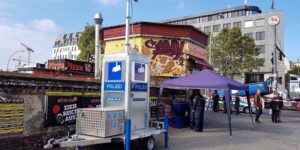
In 2017 the Berlin police put Mobile Security Box units into service for monitoring public space in the city, with Alexanderplatz among the locations. The Berliner Morgenpost covered the programme at the time.
Alexanderplatz is a useful example precisely because it is difficult. Wide open square, several rail and tram interfaces, retail frontage on three sides, footfall that changes character between a Tuesday afternoon and a Saturday night. The trouble spot is not a fixed point. It drifts across the square with the crowd, the weather and the event calendar.
Every city has a version of this. A transport interchange, a market square, a stretch of nightlife, a park that turns over after dark. The pattern is the same: the incidents cluster, the cluster moves, and the camera estate does not.
Why a fixed camera loses to a moving hotspot
A pole-mounted camera in public space is a capital project. Planning consent, a power supply, a duct run, a connection to the control room, and a position that is then correct for as long as the crime pattern holds still. Which it does not.
So a force ends up in one of two places. Either it accepts coverage that is roughly right and increasingly historic, or it starts a new civils job every time an operational picture changes. Neither is a decision anyone wants to defend to a police board or a city council committee.
Redeployable CCTV exists to break that trade-off. Put the camera where the problem is this month, move it when the problem moves, and give the operational team the decision rather than the procurement calendar.
A camera that is switched off is still doing part of the job
Worth being honest about something the Berlin coverage raised: reporting at the time found the cameras on the city’s mobile units were often not recording. That sounds like a failure. It is closer to a distinction that public space surveillance always has to make.
Deterrence and evidence are two different functions. A clearly marked unit standing six metres above a square changes behaviour whether or not a stream is being written to disk, and the decision about when recording is lawful and proportionate belongs to the force and its legal advisers, not to the equipment. What the platform has to guarantee is that it is visible, that it is stable, and that it can be somewhere else on Thursday.
For a public safety buyer that reframes the specification. The question is not which camera. It is whether the position itself can move at the speed the operational picture moves.
What redeployable has to mean in practice
The word gets used loosely. Applied strictly to public space work, it comes down to five things.
- Set up by the people who are already there. If repositioning needs a two person crew, a vehicle with a crane and a permit, the unit is not redeployable. It is relocatable, occasionally.
- No dependency on the site. No mains socket, no duct, no ground fixing, no consent for a foundation. Mains, battery, solar or fuel cell, whichever the location allows.
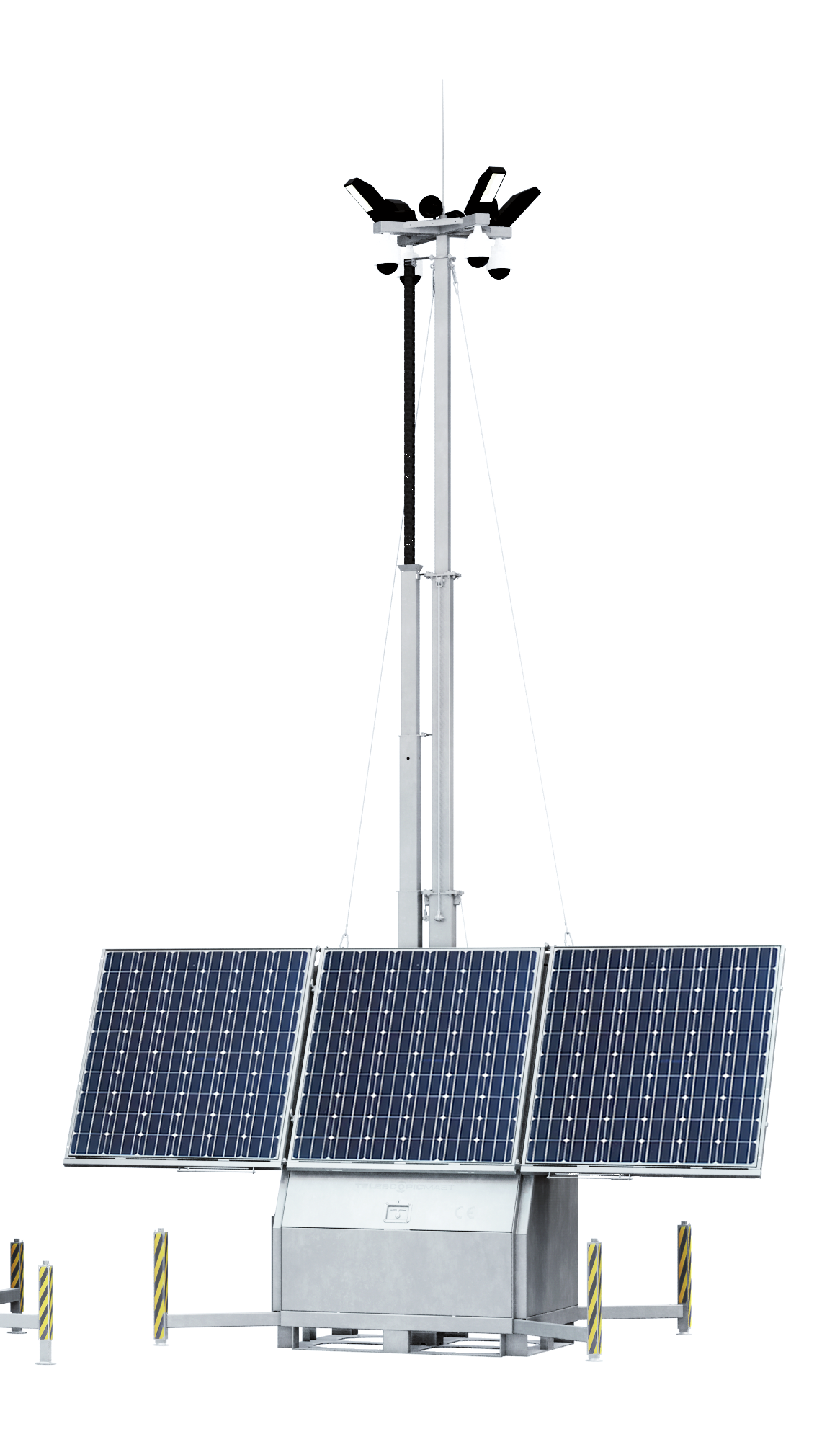
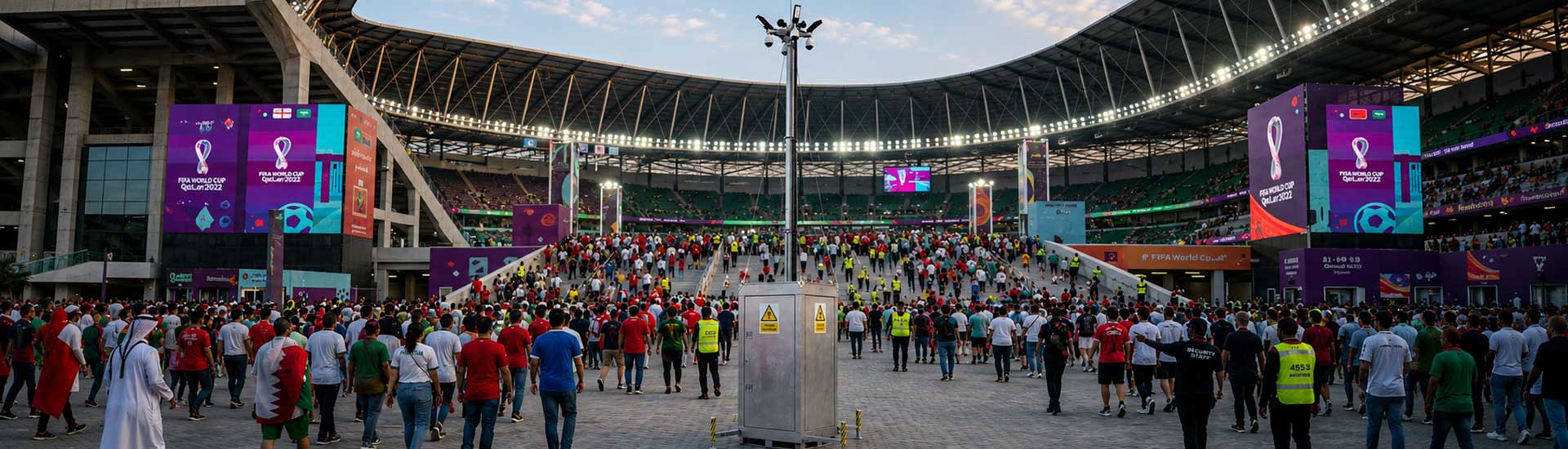
- Height that holds. Six metres gives an operator a view over a crowd instead of into the back of it. Four stainless steel stay cables keep the picture still, which is what keeps motion analytics usable rather than noisy.
- Nothing worth stealing at ground level. No wheels, no tyres, no towbar. A galvanised base with anti-climb barriers, lockable doors and lockable top covers, standing unattended in a public square.
- A paper trail. Public sector procurement asks for evidence, not assurances.
Fifteen minutes, one person
That is the operational figure worth holding on to. A Mobile Tower Platform on a galvanised steel base stands and is ready in under 15 minutes, set up by one person, with no groundwork and no grid connection. The MSB6-Premium reaches six metres in a vandal resistant steel cabinet; the MSB-Premium XL reaches 900 cm where a square needs the extra sightline.
Fifteen minutes is what changes the operating model. A unit that takes an afternoon to move gets moved quarterly. A unit a duty team can reposition before a shift gets moved as often as the intelligence says it should be, which is the entire point of buying a redeployable system in the first place.
The same logic runs through Rapid Deployment & Emergency and Crowd & Event Monitoring, and across the wider Public Safety & Defense picture.

The evidence a tender actually asks for
This is the part that decides public sector awards, and the part a specification sheet rarely covers. Every platform is CE certified by TÜV Rheinland with a 95 page test document behind it, built under ISO 9001, and also certified to ANSI and NEN standards. Fully galvanised steel, a service life of ten years or more, and 100 percent recyclable at the end of it, which matters when a sustainability weighting sits in the scoring.
For a bid team, that is a technical annexe you can attach rather than a claim you have to stand behind on your own account.
What the platform does not include
A TelescopicMast platform ships as a galvanised steel mast and cabinet with pre-drilled mounting points. No cameras, no analytics, no SIM, no VMS, no monitoring contract.
For a police force or a local authority that is usually the deciding feature rather than a gap. Forces already have a control room, a VMS estate, a retention policy and a camera standard, and often a framework that names them. A brand neutral platform drops underneath whatever is already approved instead of asking anyone to migrate. Technology Partners including Axis, Scylla, Teltonika, Milestone and SFC Energy supply what runs on top. The platform is the foundation the solution is built on, and nothing beyond that.
Frequently asked questions
What is redeployable CCTV?
A surveillance position that can be installed without fixed infrastructure, moved to a new location when the requirement changes, and removed entirely when it is no longer needed. In practice it covers redeployable domes on existing street furniture, vehicle mounted units, and mast platforms that carry the camera, the power and the connectivity on one base.
How quickly can a mobile CCTV tower be repositioned?
Under 15 minutes for a mast platform, by one person, with no groundwork and no grid connection. Transport between locations is the longer part of the job, not the setup.
Does a police force need to buy the cameras separately?
Yes. The platform is supplied without cameras or electronics, which lets a force keep its existing camera standard, VMS and retention policy. Most forces treat that as the reason to specify it.
Can it run in a square with no power supply?
Yes, on battery, solar or a fuel cell, sized by whoever specifies the payload. Mains is used where a location offers it, and the platform does not depend on it.
Is it suitable for events as well as permanent public space work?
That is the common pattern. The same units cover a market square through the winter and a festival perimeter in the summer, which is what makes the business case work. There is more on that in the article on security towers for crowd control and events and on urban safety, counterterrorism and crime prevention.
Bring us a square
The useful conversation is never about the mast. It is about a specific location, the payload that has to go up it, how often the position needs to move and who will be moving it. Give us those four and the rest follows quickly. So, which square is it?
Source
Press coverage of the Berlin programme, 2017: Berliner Morgenpost on mobile video surveillance at Berlin Alexanderplatz (in German).
Key Takeaways
- 1
The trouble spot moves across a square with the crowd and the calendar. A pole-mounted camera does not, so coverage is either roughly right or permanently historic.
- 2
Deterrence and evidence are separate functions. A clearly marked unit changes behaviour whether or not a stream is being recorded, and lawfulness of recording is the force's call, not the platform's.
- 3
Redeployable only counts if the duty team can move it themselves. Under 15 minutes by one person is what turns quarterly repositioning into weekly.
- 4
CE certification by TUV Rheinland with a 95 page test document, ISO 9001, ANSI and NEN is a technical annexe a bid team can attach rather than a claim it has to defend.
- 5
No cameras, no VMS, no monitoring contract. Forces keep their existing camera standard and retention policy and drop the platform underneath it.